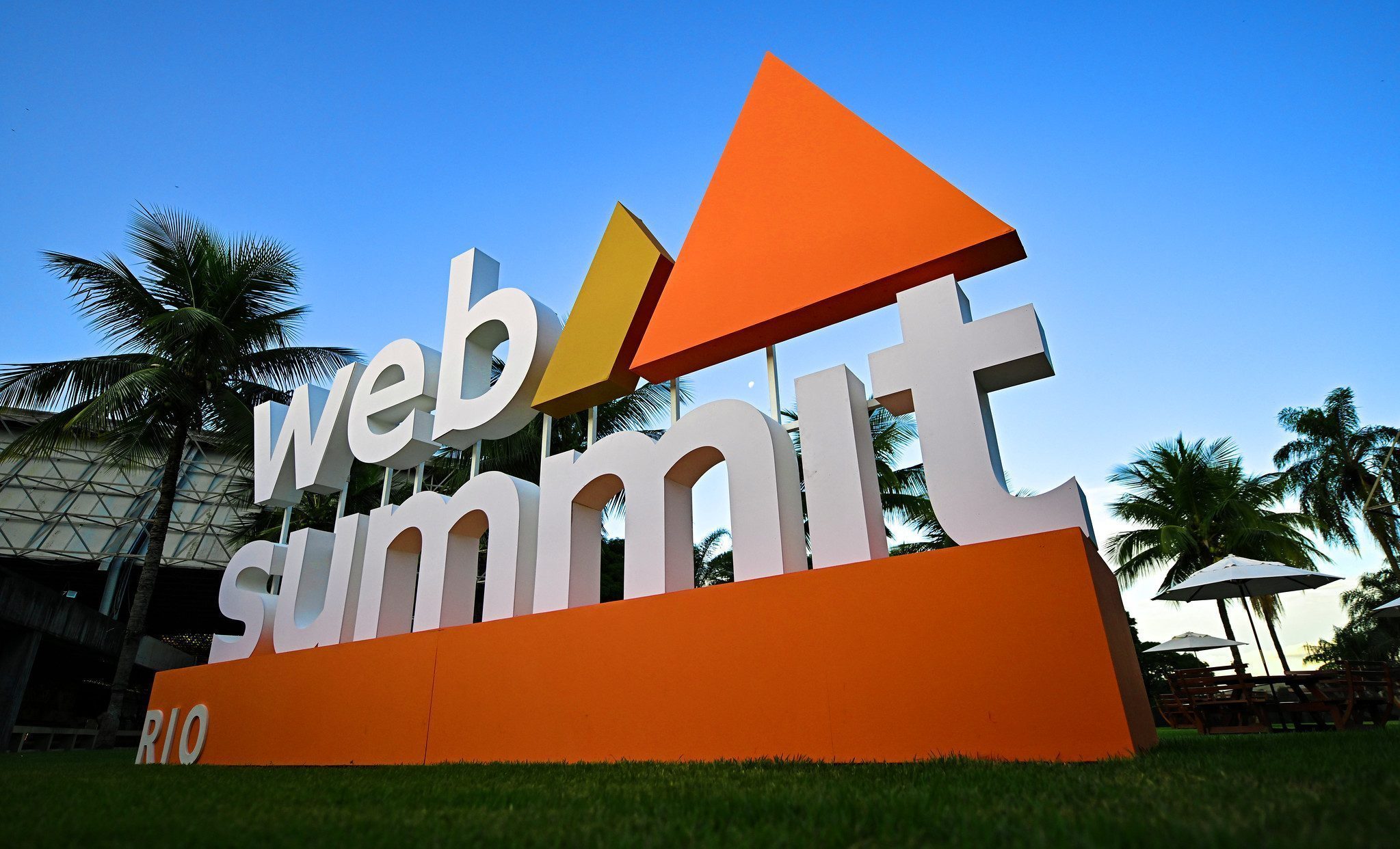

There are events that market themselves as historic even before they begin. Web Summit Rio 2026 doesn’t need that rhetorical effort. The numbers speak with the bluntness the situation demands: more than 34,000 expected participants, 1,500 startups registered, 600 investors circulating through the halls, and a speaker list spanning continents and industries. Four days at Riocentro concentrating more decision-making power, capital, and technical knowledge than most people will find in a full year of work.
This is the fourth Rio edition of the event that was born in Dublin in 2009, moved to Lisbon, and chose Rio de Janeiro in 2023 as the first city outside Europe to host the conference. That wasn’t by chance. Brazil has the largest startup ecosystem in Latin America, the largest population in the region, and a financial market that reinvented itself over the past decade at a pace few countries managed to keep up with. Web Summit came right along—and stayed.
For those attending the event for the first time, the scale can be disorienting. For those who’ve been before, the risk is the opposite: the false sense of familiarity that leads people to repeat the same mistakes. This guide exists for both profiles. It covers what’s confirmed for 2026, how the event works in practice, what to do each day, and how to get the most out of an experience that, if not used well, turns into an expensive visit to a fair with backdrop panels.
What is Web Summit, for those who have never been
Web Summit isn’t a technology conference in the conventional sense. It’s not an academic congress, it’s not a sales expo, and it’s not a corporate festival. It’s all three things at the same time—at proportions that vary depending on what you do there.
The format is built in layers. There’s the Center Stage—the main stage with seating capacity for about two thousand people—where the most visible names are. There are smaller thematic stages spread across the exhibition halls, where most of the technical and industry content takes place, usually with a more select audience and deeper discussions. There are the masterclasses, with limited seats and mandatory booking through the app, where the dynamic is workshop-style and access to the speakers is unparalleled. And there’s the exhibition area, the event’s commercial heart—where startups, established companies, and sponsors set up booths, and where most conversations that turn into business begin.
Outside the exhibition halls, Web Summit has a second life: the Night Summit. During the first three nights (June 8, 9, and 10), the organizers put together exclusive events for accredited participants, each with a different theme and atmosphere. In previous editions, the Night Summit took over Riocentro’s outdoor area, moved to iconic spaces around the city, and worked as the setting where some of the most relevant connections happened. There’s something that the informal party environment—music and drinks—does for conversations that three hours of panel discussions can’t: it reduces hierarchy. A startup founder can talk to an investor in a way they could hardly manage by requesting a formal meeting.
What’s on the 2026 program
This year’s edition brings together three core pillars that organize most of the content distributed across stages and multiple thematic tracks.
Applied artificial intelligence: the debate moved beyond theory
Web Summit Rio 2026 marks a shift from earlier editions in how the topic is treated. The debate about what artificial intelligence could become gave way to what it already is—and what to do with it. This year’s sessions focus on real implementation: how companies are using AI in operations, product management, and software development in environments with the typical cost and infrastructure constraints found across Latin America.
Michele Catasta, President and Head of AI at Replit, brings to Center Stage the topic of applied AI to software development, discussing what happens when writing code stops being a barrier to entry for building products. Google Cloud confirmed masterclasses about AI agents. Meta has a session in the program called “AI leaders’ guide,” the so-called “8% playbook,” referring to the percentage of leaders the company identifies as having transformed real processes with AI—unlike those who merely introduced tools without changing anything structural.
On June 9, between 12:25 and 12:55, Center Stage hosts a panel that deserves special attention from anyone thinking about technological infrastructure. Rodrigo Duclos, Chief Innovation and Digital Officer at Claro, and Marcio Aguiar, Executive Director of NVIDIA for Latin America, map the architecture companies have been building toward 2026: cloud, connectivity, and processing capacity integrated into a stack built with an eye on the Brazilian market. The panel is in Portuguese.
Fintechs and money in Latin America
No region in the world has undergone a faster financial transformation in the last ten years than Latin America. Brazil moved from a highly concentrated and expensive banking system to one of the most advanced digital payments ecosystems on the planet. Web Summit Rio 2026 reflects the weight of that shift.
Luana Lopes Lara is from Minas Gerais, a former Bolshoi ballerina, trained at MIT, and cofounder and COO of Kalshi, an events contracts exchange and the largest of its kind in the United States. At 29, she is the youngest woman to become a self-made billionaire in the world. On June 8, between 6:30 p.m. and 7:00 p.m., she takes the stage at Center Stage for a session called “Trade the future,” alongside Tom Giles from Bloomberg. It’s one of the most anticipated opening sessions of the edition.
Gerry Giacomán Colyer, cofounder and CEO of Clara, a corporate expense management platform that has become one of the region’s leading unicorns, is confirmed to discuss expansion and capital in emerging markets. João Del Valle, cofounder and CEO of EBANX, brings the perspective of someone who scaled a fintech in emerging markets until it became a global reference.
Sustainability and green technology
The third thematic pillar is the one growing the most in global relevance, and Web Summit Rio 2026 treats it with matching seriousness. CleanTechs, the circular economy, and the role of technology in the energy transition all have dedicated tracks. For anyone working in agribusiness, logistics, energy, or any industry that faces regulatory and market pressure around emissions, this block of programming offers context that’s hard to find concentrated in one place.
The confirmed speakers
The speaker list for this edition reveals a deliberate editorial choice: Web Summit Rio 2026 isn’t just a technology event—it’s a meeting of worlds that rarely share the same stage.
On the side of major global corporations, there are Priscyla Laham, President of Microsoft in Brazil; Fábio Coelho, President of Google Brazil; Rodrigo Moran, Global Head of Creative at Meta; Marcio Aguiar, Executive Director of NVIDIA for Latin America; Mark Chen, LatAm President of Huawei Cloud; Will Abbey, EVP and CCO at Arm; Cleber Morais, Managing Director of AWS Brazil; and Milena Leal, Brazil Country Manager for Google Cloud. IBM is represented by Marcelo Braga, CEO in Brazil. Replit, in addition to Michele Catasta on the main stage, has Marcelo Echeverria as its Brazil Country Manager.
OpenAI is present with two complementary profiles: Bruno Lewicki, Head of Public Policy Latam, and Christian Rôças (Crocas), Head of Community, Influencers, and Talent, who leads a session in the “Ask Community” format—where the content is defined live by what the audience wants to know for real.
On the side of capital and startups, there are Eric Acher and Marcelo Lima from Monashees, and Euwyn Poon, founder and CEO of Orbital. Gerry Giacomán Colyer, cofounder and CEO of Clara, and João Del Valle, cofounder and CEO of EBANX, bring the perspective of those who scaled fintechs in emerging markets until they became a global reference. Dileep Thazhmon, cofounder and CEO of Jeeves, rounds out this block.
Public power has unusual representation for a technology event: Eduardo Cavaliere, Mayor of Rio de Janeiro; Luis Fernandes, Vice Minister of Science, Technology and Innovation of Brazil; Sonia Guajajara, the first Minister of Indigenous Peoples of Brazil; and Paulo Guedes, former Minister of the Economy. Henna Virkkunen, Executive Vice President of the European Commission for Technological Sovereignty, Security, and Democracy, brings a European regulatory perspective, increasingly relevant to any company operating at a global scale.
Science is represented by Carlos Nobre, a climate scientist and Nobel Peace Prize laureate (IPCC), and Xianmin Jin, founder of TuringQ, a quantum computing company. Nobre’s presence at a technology event isn’t decorative: conversations about sustainability happening at Web Summit Rio have more and more real weight in investment decisions.
Culture and entertainment are among the richest sides of this edition. Juliette Freire Feitosa, who built a solid career as an artist and businesswoman; Kyra Gracie, world champion in jiu-jitsu; Fábio Porchat, founder of Porta dos Fundos; Marcela Ceribelli, creator of the podcast Bom Dia, Obvious; Glenn Greenwald, investigative journalist and founder of System Update; Federico “Panda Boi” Hu, an influencer with a massive audience; Ricardo Cubba, actor and content creator; and Lázaro Ramos, Deborah Secco, Rebeca Andrade, and Denílson de Oliveira round out the group that makes Web Summit Rio unlike any other technology conference in the world.
On the Brazilian corporate side, there are Tarciana Medeiros, CEO of Banco do Brasil; Liel Miranda, CEO of Alpargatas; Marcelo Zimet, Chairman and CEO of L’Oréal Brazil; Marcelo Lombardo, founder and CEO of Omie; Fabio Barreto, Global CEO of FARM Rio; and Sissi Freeman, CMO at Granado. Taciana Lopes, SVP of Marketing and Communications in Brazil at Mastercard, and Patricia Muratori, Latam Managing Director at YouTube, represent the marketing and digital platforms pillar.
A programming curiosity: the G1 Robot from Unitree is listed as a speaker, presented as an “AI humanoid agent with an avatar.” It’s the kind of detail that says a lot about where the event conversations are headed.
How the event works day to day
Understanding the rhythm of Web Summit is as important as knowing the names in the program. Anyone who arrives without that context tends to spend the first day disoriented, and the other two days catching up.
June 8 (Monday): opening
The first day is the most unpredictable in terms of logistics. The formal opening takes place at Center Stage and draws the largest number of people trying to be in the same place at the same time. The main hall fills up early; the lines for accreditation can stretch for hours; and some participants who arrive late in the afternoon can’t even get into the main stage.
The strategy from people who’ve been in previous editions is consistent: pick up your badge in the morning of June 8, before the sessions begin, and don’t treat Center Stage as a priority on that day. The thematic stages and the exhibition area operate with less pressure and offer more direct access. Luana Lopes Lara’s session at 6:30 p.m. is the anchor of the day. Save your energy for it.
In the evening, the first Night Summit of the edition begins.
June 9 and 10 (Tuesday and Wednesday): the heart of the event
The two most content-dense days. The thematic stages run in parallel, which means that at any given time there are at least five or six sessions happening simultaneously. The need to choose is real: you can’t be everywhere, and trying to do that means you truly won’t be anywhere.
Masterclasses require pre-booking through the app, and seats sell out quickly. Anyone interested in a specific session in this format should book in advance—preferably on the first day.
On June 9, Center Stage welcomes at 11:10 a.m. the session “The perfect feed is dead,” featuring Rodrigo Moran from Meta and Fábio Porchat. At 12:00 p.m., the session “Who does truth belong to?” brings together Julie Pace from Associated Press and other journalists and leaders from global outlets. At 12:25 p.m., the panel on AI infrastructure with NVIDIA and Claro.
The Tuesday Night Summit is the second of the edition, and the Wednesday one is the third and last.
June 11 (Thursday): closing
The formal program is shorter. The focus shifts to networking and to the startups’ final pitching rounds. Many participants use the afternoon to close meetings they started in the previous days, when hallway conversations and the Night Summit turn into concrete commitments. Anyone who leaves early tends to regret it: Thursday morning is the last real window for conversations that fell by the wayside.
How to get to Riocentro
The Riocentro Convention and Events Center is located at Av. Salvador Allende, 6,555, Barra da Tijuca. There is no metro line with direct access.
The most commonly used combination is metro to Jardim Oceânico Station (Line 4), followed by BRT to Centro Olímpico, and from there another BRT line to Riocentro. The trip takes between 30 and 50 minutes from Ipanema or Copacabana, and the departure time makes all the difference. Leaving home at 8:00 a.m. and arriving at 9:00 a.m. is a completely different experience from leaving at 9:30 a.m. and arriving at 11:00 a.m.
Uber and 99 ride-hailing apps work well in the area. If you’re driving, Riocentro has parking for up to 7,000 vehicles, but traffic entering and leaving can be slow on the busiest days—especially on opening Monday.
The most valuable practical tip on this front: staying in Barra da Tijuca solves the logistics problem almost completely. The area offers plenty of hotels and apartments, and the quality-of-life difference during the four days is substantial. Anyone coming from outside Rio with that flexibility shouldn’t ignore this option.
What to do to truly make the most of it
Events of this scale are democratic in terms of access and deeply unequal in results. Two people with the same badge can have experiences that are nothing alike. What separates one from the other is rarely luck.
Plan ahead, not during
The official Web Summit app is the main navigation tool within the event. It brings together the full program, allows you to book masterclasses, and includes networking features that connect participants before the event even starts. Anyone who gets to Riocentro without opening the app ahead of time is making an expensive decision.
Decide which track makes sense for you
Choosing one or two tracks as your main focus and complementing them with Center Stage sessions is more productive than trying to cover everything randomly. The applied AI, fintech, sustainability, and B2B SaaS tracks have especially dense programming in this edition.
Use the expo booths, not just the stages
The exhibition area is where some of the most interesting startups in the event showcase themselves. Many are Brazilian, tackle real problems, and are at stages where a direct conversation with the founder is still possible. If you’re looking for suppliers, partners, or simply want to understand where the market is headed, walking through the expo area with attention is more rewarding than sitting through yet another talk.
Let people know you’ll be there
LinkedIn posts in advance, making it clear that you’ll be at the event and available for conversations, work. “Spontaneous” meetings inside Riocentro often start with messages exchanged days earlier.
Go to the Night Summit all three nights
Access is included in the accreditation for most ticket types. The parties are packed, so arriving early makes a difference. The informal environment is where conversations with investors, speakers, and founders happen in a way no meeting room replicates.
Book the masterclasses on the first day
Seats are limited and sell out quickly. Don’t wait until the second day to do what you can do right after picking up your badge.
Take care of logistics for your body
Four days standing up, walking between halls, in June in Rio de Janeiro. Comfortable shoes aren’t optional. A portable charger also isn’t. Your phone is the main work tool inside the event: without battery, you lose the app, you lose contacts, and you lose the ability to capture anything relevant.
Follow Center Stage on YouTube if you can’t get in
All main stage content is streamed live on the Web Summit YouTube channel, open to the general public.
Web Summit as journalistic coverage
For those covering the event as media, Web Summit Rio 2026 offers something that few events manage to bring together: a concentration of sources, diverse perspectives, and a level of access to leadership that’s hard to replicate in a traditional press agenda setting.
Anyone who has been to the Lisbon editions knows the event has its own logic that takes time to learn. The first years are disorienting: the scale is intimidating, the parallel programming is confusing, and the temptation to stay seated all day in front of Center Stage is real. Over time, your understanding changes. The value of Web Summit for a journalist isn’t in the prepared speeches from the biggest stages. It’s in what happens before and after them.
Panels are the starting point, not the destination. The most interesting moments in coverage of an event of this size happen in the hallways, during breaks, and at the booths. A well-asked question to a CEO who just got off the stage yields more than any press release. The startups exhibition area is particularly fertile: there are early-stage companies solving problems nobody has covered yet.
The Night Summit is legitimate editorial territory. The conversations that happen there reveal the real state of the market—without the public relations filter and without the pre-written stage script.
The programming in Portuguese is extensive in this edition, with simultaneous translation available via the app for sessions in English, which makes coverage easier for the Brazilian audience.
What Web Summit Rio means for Rio de Janeiro
In recent years, Rio de Janeiro has solidified an identity that goes beyond tourism and beyond Carnival. The city has come to be seen internationally as a hub for innovation and technology in Latin America—and Web Summit accelerated that process. Founders and investors who come to the event for the first time to talk about startups leave with a different perception of the city. Some return with plans to set up offices, open operations, or invest in the local ecosystem.
The 2025 edition consolidated what the first edition had started and what the second had expanded. 2026 arrives with proportional expectations: more participants, more investors, more startups, and a program—across the applied AI and fintech tracks—that aligns with what’s most relevant in the global technology debate.
Practical information
Dates: June 8 to 11, 2026 (Monday to Thursday)
Location: Riocentro Convention and Events Center, Av. Salvador Allende, 6,555, Barra da Tijuca, Rio de Janeiro
How to get there by public transportation: Metro Line 4 to Jardim Oceânico, BRT to Centro Olímpico, BRT to Riocentro (30 to 50 minutes from the South Zone)
Ride-hailing apps: Uber and 99 operate in the area
Parking: available for up to 7,000 cars on site
Full program: rio.websummit.com/pt-br/schedule
Speakers list: rio.websummit.com/pt-br/speakers
Official app: available for iOS and Android
Night Summit: 3 nights (June 8, 9, and 10), included in the accreditation for most ticket types
Live streaming: Web Summit on YouTube, free and open to the public
Superplural has covered Web Summit since 2021, present at all Lisbon editions before arriving in Rio. For five years, we’ve been following the event from the inside, talking with founders, investors, and global leaders on stage and beyond it. In 2026, for the first time as an accredited media outlet in Rio de Janeiro, the team will be there for all four days at Riocentro with reports, interviews, and real-time coverage.