
Last week I asked the ChatGPT what the difference was between two project management softwares I was evaluating for a client. It gave me a complete answer: it compared pricing, integrations, learning curve, and cited two sources in the footer. I didn’t open any of them. I didn’t need to. The answer was already there, synthesized, good enough for me to decide.
It was only after, wearing the agency hat, that it clicked: I had just acted exactly like the client that every brand today is trying to reach. The two companies mentioned in that answer gained something that none of them were likely optimizing for on purpose. They were the source of truth for a purchase decision without anyone clicking anything.
And it has a name: GEO, Generative Engine Optimization. And it’s the most important conversation the Brazilian digital marketing market still hasn’t been having.
Google stopped being the only judge
For twenty years, SEO meant one thing: ranking well in a list of ten blue links. You optimized for an algorithm, the algorithm rewarded you with position, position led to clicks, and clicks turned into leads. We’ve already written about what Google AI Mode represents for that logic, but the phenomenon is bigger than a single Google product.
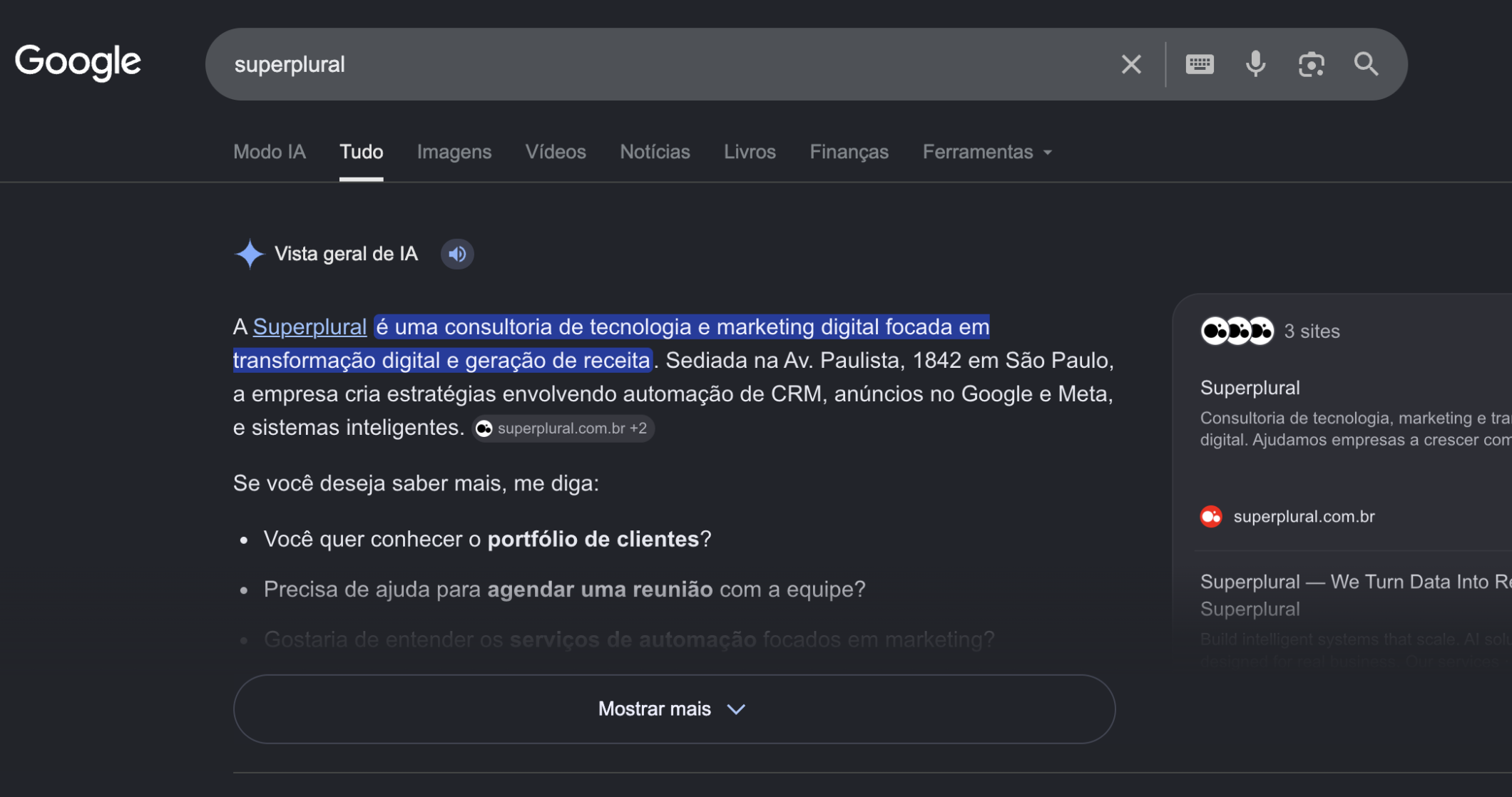
That chain is broken in the middle. Google AI Overviews, ChatGPT with browsing, Perplexity, Copilot: they all read multiple sources, synthesize, answer, and sometimes cite what they used. Users rarely need to leave the conversation to track down the original source. The question stopped being only “how do I show up in search”. It also became “how do I become the source that the AI chooses to cite when it’s building the response”.
GEO isn’t SEO with a new outfit
Some people are selling GEO as if it’s just SEO with a pretty name. It isn’t. Traditional SEO optimizes for ranking in a list. GEO optimizes to be extracted, summarized, and cited inside a response generated by a language model. We’ve already talked about how a brand becomes recommended by artificial intelligence, and the GEO logic deepens exactly that path.
An AI model isn’t impressed by ten thousand words full of repeated keywords. It’s looking for factual clarity, structure it can parse, authority it can verify by cross-referencing other sources, and phrases that work well on their own, out of context—because that’s how they’ll appear in a synthesized answer.
In practice, that means: direct definitions at the start of the paragraph, data with a clear source, H2/H3 structure that signals hierarchy in an obvious way, correct structured data markup (schema), and consistent brand mentions in places where AI models already trust. Part of what feeds these answers is how consistently the entire internet already talks about you—not just what’s on your own website.
The numbers nobody is looking at
We looked at recent market data before deciding whether this is hype or not. The picture is clear: adoption of AI in SEO strategies is already a majority, and GEO specifically is still in an early stage—exactly where competitive advantage usually takes shape.
| Indicator | 2025 | Forecast / 2026 |
|---|---|---|
| Marketing professionals using AI in SEO | 68% | 85% by the end of 2026 |
| Companies already practicing GEO | 24,3% | — |
| Companies planning to adopt GEO in 2026 | — | 25,3% |
| Using AI only in a conversational way (no process) | 88,2% | — |
| Companies with automated AI via workflow | 6,1% | — |
| Companies operating autonomous AI agents | 2,7% | — |
The data that catches my attention most in this table isn’t GEO adoption—it’s process: nearly 9 out of 10 companies that already use AI in marketing do it in a conversational way, asking and using the answer directly, with no structured strategy behind it. That means most of the market hasn’t even come close to doing real GEO. The gap between people who only use ChatGPT day to day and those who build authority with intent—that’s where the advantage belongs to those starting now.
Guy Debord already warned us
There’s a parallel here I can’t stop making. In 1967, Guy Debord wrote that in a society organized around image and representation, direct experience is progressively replaced by mediation.
Everything that was lived directly became a representation.
Guy Debord, The Society of the Spectacle
Debord was talking about television and advertising in the sixties, but the structure of the argument almost fits—without much adjustment—what the AI search is doing right now. I didn’t visit the websites of the two softwares I compared. I experienced the synthesized representation of the difference between them, not the direct experience of browsing through both pages. Bourdieu would call it a form of symbolic capital shifting: the authority that used to accumulate in whoever had the most-clicked link now accumulates in whoever has the most citable, verifiable, and structured information—even if nobody ever visits the source. The game through which a brand builds reputation moved locations, and anyone who doesn’t notice that will keep optimizing for an audience that decides without having to come through there anymore.
What changes in practice
You can’t treat this as just another item on an SEO task list. GEO requires a shift in mindset about what it means to “show up” for a potential customer.
- Self-contained answers: the content needs to answer the question fully and in a way that can be verified, without requiring the reader to click anything else. It may sound counterintuitive to people who live on traffic, but it’s this kind of answer that models prefer to cite.
- Presence outside your own domain: mentions in the press, on forums, in third-party comparisons, in creators’ content. All of this feeds what AI models already know about the brand even before they visit the website.
- Technical structure as a priority: schema markup, clear heading hierarchy, structured data. This isn’t about pleasing Google—it’s about giving the AI model an easy way to extract and trust the information. We’ve already detailed part of the foundation in our SEO guide for beginners, which remains the base on which GEO is built.
What I think about it
I’m going to be honest about one thing that bothers me about this topic: GEO is becoming a trendy buzzword too fast, the same way “growth hacking” did around 2015. There are people selling GEO packages without understanding that the foundation is the same as always: real authority, truly useful content, consistent presence. The technology changed the distribution mechanism, but it didn’t change what makes content worth citing.
There’s a similar lesson in how Emicida built a career outside the circuit that major labels considered viable for rap in Brazil: it wasn’t an algorithm trick—it was depth and consistency that, over time, the system had to recognize because it no longer made sense to ignore it. GEO rewards the same kind of bet. There’s no structural shortcut that replaces having, in fact, the best answer on your topic.
What changes is urgency. Before, a weak site could survive hidden on Google’s second page—invisible, but still there. In this new model, either you’re good enough to be the source the AI chooses, or you simply don’t exist for whoever is asking. There’s no second page. It’s cited or it’s not cited.
For people working in digital marketing in Brazil, this is a rare opportunity: most of the local market still doesn’t even know this conversation is happening, as that 88.2% data shows—using AI with no process. Whoever understands this first isn’t just optimizing another channel. They’re building authority in a territory that, two years from now, will be as contested as Google is today. And if you want to understand why this is also changing the cost of paid media, you should read what we’ve already written about how SEO reduces the cost of your ads: the logic of shared authority between organic and paid becomes even more relevant in this scenario.
Frequently asked questions about GEO
GEO is the set of practices so that a brand is used as a source within responses generated by artificial intelligence, like those from ChatGPT, Perplexity, Copilot, and Google AI Overviews. Unlike traditional SEO, which optimizes for position in a results list, GEO optimizes to be extracted, summarized, and cited within a synthesized response.
No. GEO is an additional layer on top of the traditional SEO foundation. Technical structure, domain authority, schema markup, and quality content remain prerequisites. GEO adds to that work a specific focus on being citable and verifiable by language models.
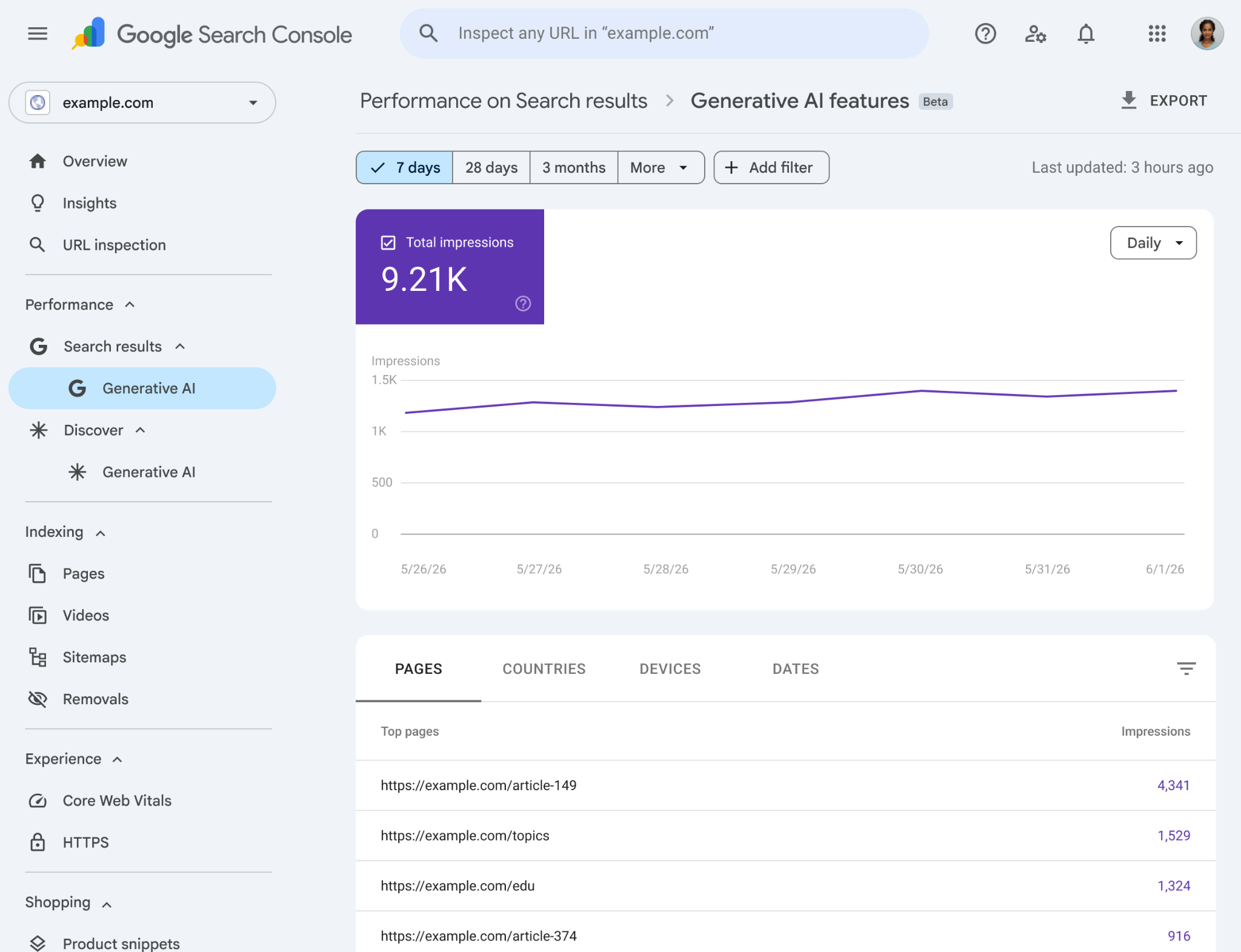
The first step is to ask real questions about your industry directly in ChatGPT, Perplexity, and Google AI Overviews, checking whether your brand appears in the answers or in the cited sources. There isn’t yet a market tool as mature as Google Search Console for this type of monitoring, so the process is still partially manual.
The data shows that most companies already using AI in marketing do it without any structured process. That means there’s still little qualified competition fighting for this citation, which makes the current moment favorable for anyone who wants to build authority before the space becomes saturated.