
In the post about how to monitor whether your brand is mentioned by AI, I wrote that there was no official Google tool equivalent to Search Console for this kind of monitoring, and that the manual process was the only path available. On June 3, 2026, Google launched this tool inside Search Console itself. It covers part of the problem. The most important part is still unanswered.
What the new report shows
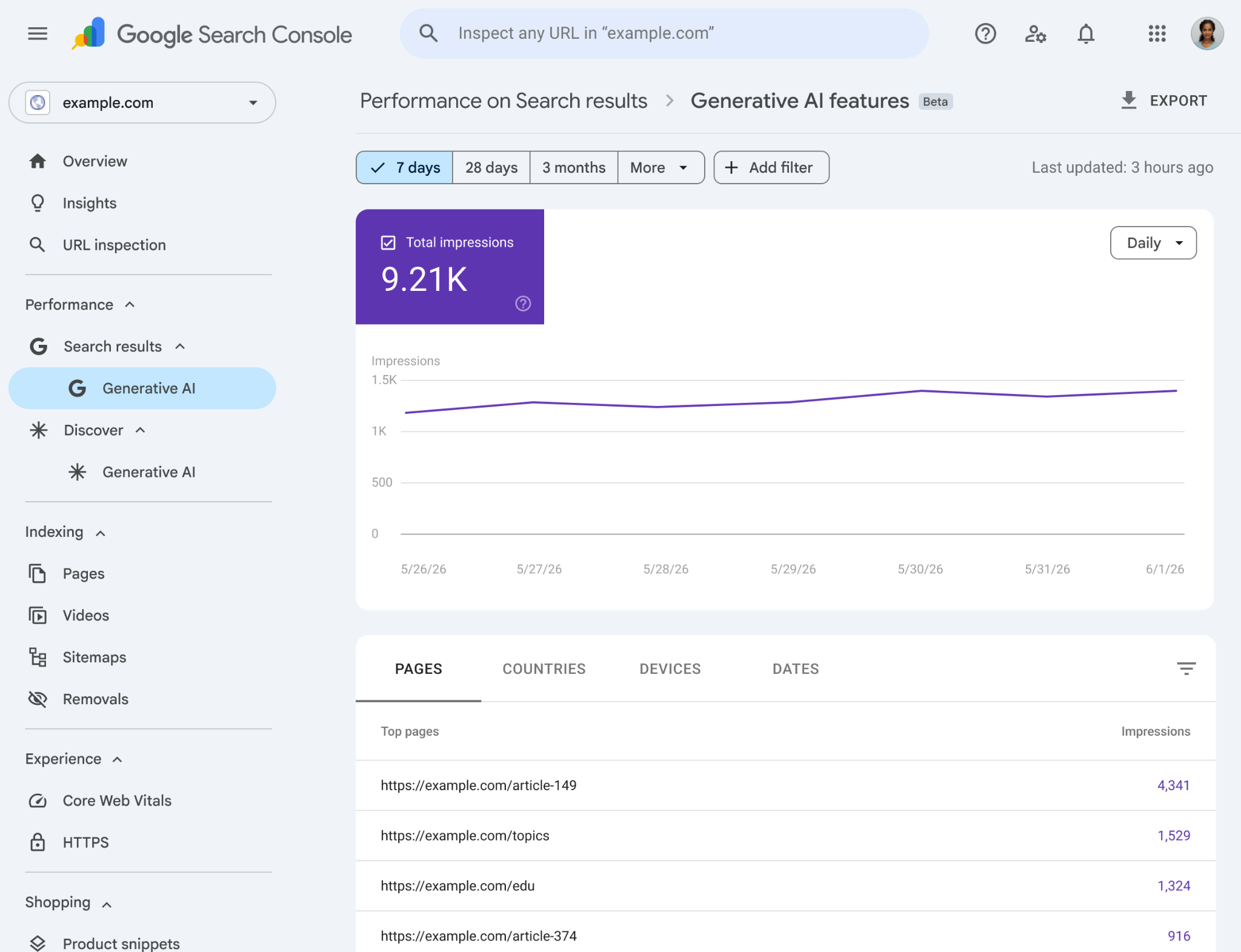
The Generative AI performance report now shows, in a separate tab, impressions of your site in AI Overviews, AI Mode, and Google Discover’s AI features. The data is broken down by page, country, device, and period, with granularity from hour to month. None of this is truly new: as Zinc Digital’s analysis explains, these impressions have always been counted in the Search Console overall total; Google just separated them into a dedicated view.
The rollout initially started limited to a small group of sites, with priority given to the UK before the global expansion. If that tab doesn’t show up in your property yet, it’s because access hasn’t reached it—no configuration issue.
What’s still missing
The report shows impressions—only that. No click, no CTR, no query data. You find out that you appeared in an AI response, but you don’t know whether someone clicked, you don’t know how much traffic that generated, and you don’t know which specific question brought you there. It’s visibility without proof of results—the exact opposite of what made the traditional Search Console useful for fifteen years.
The blocking control
Along with the report, a control was introduced to block your content from appearing in AI features, and it has been respected since June 17, 2026. One detail worth highlighting: choosing to opt out doesn’t affect your normal search ranking; it’s an isolated decision only about presence in AI. According to a Search Engine Land poll with more than 350 respondents, 41.9% of professionals do not plan to block Google from using their content in AI features, versus 33.2% who plan to block it.
The tension with the GEO thesis
I’ve argued in this blog, in more than one post, that being cited by AI is the new currency of visibility. The blocking control exists because this thesis doesn’t hold the same way for everyone. The right question isn’t whether GEO is worth it; it’s how a specific business converts.
The same Digital Applied analysis proposes a framework by business model that matches exactly what I’ve been thinking: a paid-subscription publisher, where the value per reader is high and conversion from an AI-summarized visit is low—this is the strongest case for blocking, because a generated summary can replace the visit that would have led to a subscription. A site supported by ads depends on pageviews, so blocking means giving up future traffic for no reason. E-commerce and local business, with transactional intent, are rarely replaced by an AI summary. B2B SaaS and agency—my case—benefit from brand impressions in AI citations, because conversion doesn’t happen in the same session; it happens later, through the sales funnel.
| Business model | Block or appear in AI? | Why |
|---|---|---|
| Paid-subscription publisher | Consider blocking | An AI summary can replace the visit that would have generated a subscription |
| Ad-supported site | Appear | Depends on pageviews; blocking means giving up future traffic |
| E-commerce and local business | Appear | Transactional intent is rarely replaced by a summary |
| B2B SaaS and agency | Appear | Conversion happens later, through the sales funnel—not in the same session |
The decision between GEO and blocking depends on a specific question: does revenue come from direct clicks or from being remembered later through the sales funnel. Selling GEO as a universal strategy, without considering this difference, ignores how each business model actually converts.
To exist without being visited
The Brazilian researcher Muniz Sodré coined the term media bios to describe a mode of existence that started to be worth as much as physical life—the existence mediated by media vehicles. What generative AI is creating right now is an even stranger version of that: you can exist inside an AI response, be cited, be mentioned, without anyone ever physically visiting the place where that information came from. This isn’t exactly new: appearing in a news report without the reader looking up the original source was already like that. But the scale and automation of it now is of a different order.
What to do while the report doesn’t reach your site
For most Brazilian sites, that tab doesn’t exist yet. Meanwhile, the process continues to be the same one I described in the monitoring post: run your own questions through AI platforms, record whether your brand appears, and repeat regularly. The new report will eventually automate part of this, but even when it arrives, half of what measures real results will still be missing. Genuine built authority, not the report, is what decides whether you appear there or not.
Frequently asked questions
O que o novo relatório de IA do Search Console mostra?
Impressions of your site in AI Overviews, AI Mode, and Google Discover’s AI features, broken down by page, country, device, and time period. It doesn’t show clicks, CTR, or which queries generated the citation.
Bloquear meu conteúdo de aparecer em IA prejudica meu ranqueamento no Google?
No. The blocking control is isolated: it only affects your presence in AI features, with no impact on normal search ranking.
Devo bloquear meu conteúdo de aparecer em respostas de IA?
It depends on how your business converts. Paid-subscription publishers have the strongest case for blocking. Sites with ad revenue, e-commerce, local business, and B2B companies or agencies generally benefit more from keeping visibility in AI than blocking it.
Por que meu site ainda não tem essa aba no Search Console?
The rollout started restricted to a small group of sites, with priority given to the UK before the global expansion in June 2026. Most sites, including most Brazilian sites, are still in the queue.