
For years, “how many times should my ad be shown to the same person?” was one of the most frequently answered questions, based on educated guesses in media planning. Each manager had their own magic number, usually inherited from some course or a “back-of-the-envelope” rule repeated without a clear origin. This week, Google published a number backed by research, and rolled out a new tool to apply that number automatically to video campaigns on YouTube.
What Google launched
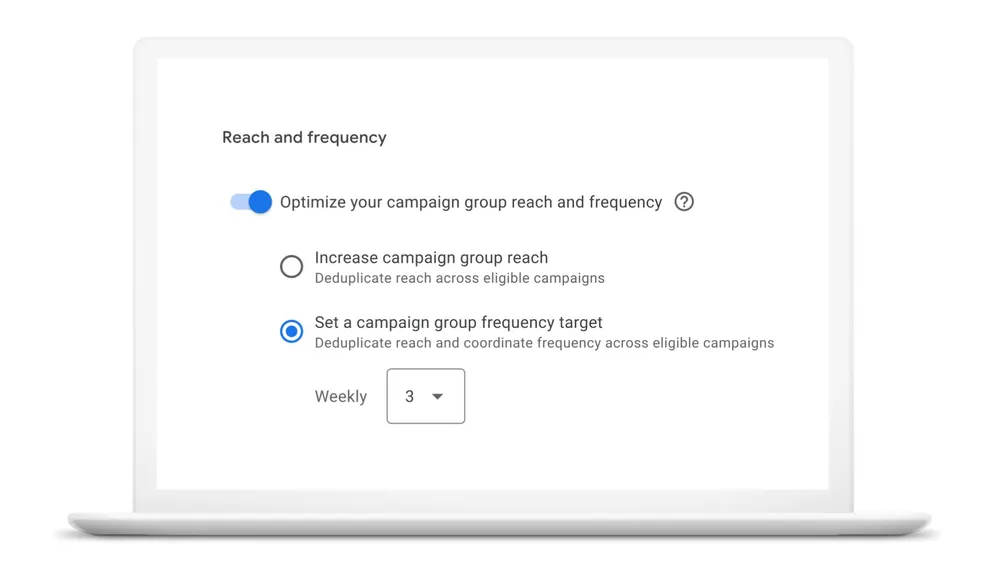
It’s called video campaign groups, and it’s already available globally in Google Ads. The core idea is simple to explain and reasonably new in practice: instead of optimizing frequency and reach campaign by campaign, in isolation, advertisers can now set a single reach or frequency goal that applies to multiple video campaigns at the same time—while keeping budget and creatives configured individually in each campaign. The system coordinates delivery across the campaigns in the group to maximize unique reach and frequency efficiency, with a unified report showing unique reach and the group’s average weekly impressions, according to the official Google announcement. The feature rolls out first to the Google Ads standard version, with the pro version for Display & Video 360 promised “soon,” with no specific date.
The science behind the number Google is pushing
The launch is backed by a Meridian study—the marketing mix model from Google itself—analyzing data from about 600 American brands between 2023 and 2025. The key finding: an optimal frequency of 2.7 exposures per week leads to a 19% increase in return on investment compared to lower or higher frequencies than that point.
This didn’t come out of nowhere. Brazilian market studies had already been pointing in the same direction before this announcement: campaigns with frequency above 3.4 show an average 25% drop in CTR compared to the starting point, according to a survey by Shiftmind. The generally suggested healthy window is between 1 and 3 exposures for brand recognition campaigns, with recall research indicating that 2 to 3 exposures are already enough for the message to be remembered.
What the numbers show, side by side
| Weekly frequency range | Observed effect | Source |
|---|---|---|
| 1 to 3 exposures | Considered a healthy range for brand recognition campaigns | Shiftmind |
| 2 to 3 exposures | Enough for the message to be effectively remembered, according to recall studies | Shiftmind |
| 2.7 exposures/week | Identified sweet spot, with +19% ROI versus frequencies outside this range | Google Meridian MMM |
| Above 3.4 exposures | Average 25% drop in CTR compared to the starting point | Shiftmind |
The pattern that stands out is the convergence: an American study with a media mix panel, Brazilian agency market data, and established recall practice all land practically in the same interval. That’s rare enough to take seriously, even when the sources have very different methodologies.
Durkheim would explain why repetition was never only about remembering
Émile Durkheim wrote about how repeated rituals create and sustain collective consciousness: it’s not the information of the ritual that matters, it’s the shared repetition that produces the feeling of belonging to something greater than the individual. Advertising frequency works in a similar way, and that’s why the right number was never only about memorizing the message. A brand that appears at the right frequency isn’t just being remembered—it’s being integrated into what the person recognizes as part of their everyday environment, the way a repeated ritual becomes part of social life without anyone needing to memorize the reason. Moving past the ideal frequency breaks that effect and flips it: intrusion, not belonging.
Does the American number apply to Brazil?
Here, it helps to keep a dose of healthy skepticism. The Meridian study used data from American brands. Video consumption habits in Brazil have real specificities: average phone session length is longer for certain profiles, the connection environment is more unstable in parts of the country, affecting actual exposure frequency versus programmed frequency, and there’s a local content creator market competing for attention in a way the American market doesn’t replicate exactly the same. The Shiftmind numbers, from a Brazilian source, help validate the general range, but I’d treat “2.7 per week” as a starting point for testing—not as imported truth to apply without question.
Update: after publishing this post, we organized our own frequency data from campaigns managed in Brazil. The real result is in the Superplural Analytics: Digital Ad Benchmarks Brazil and Portugal, including a downloadable PDF.
Who really benefits from this new tool
Let’s be honest about this: coordinating frequency across multiple video campaigns only makes a practical difference for advertisers who already run multiple video campaigns at the same time, targeting the same audience. A small advertiser with one or two active campaigns gains almost nothing from this specific feature, because there’s no audience overlap to coordinate. This is a feature designed for medium to large advertisers, with more complex media operations. If you’re a small business testing video ads first, the real gain is still in getting frequency right within a single, well-configured campaign—not in a coordination tool across multiple campaigns.
Frequency without new creative is the same fatigue with a different name
There’s a detail that no “frequency feature” ad will highlight, because it’s not a problem media tools can solve on their own: controlling how many times the same video appears doesn’t help much if the video itself never changes. Meta’s practical recommendation for ongoing campaigns is to refresh the creative every two or three weeks—exactly to prevent the fatigue curve from showing up before you hit the configured frequency cap. A goal of 2.7 exposures per week, well calibrated, running the same creative for two straight months will still tire the audience—just more slowly. Frequency and creative rotation are two variables of the same problem, and addressing only one solves half of it.
How to set up a video campaign group, step by step
Basic process for creating and configuring a video campaign group with a coordinated frequency goal in Google Ads.
- Confirm that your video campaigns compete for the same audience
Before grouping, check that the campaigns truly compete for the same audience. Grouping campaigns with completely different audiences provides no coordination benefit.
- Create the campaign group inside Google Ads
In the video campaigns section, use the option to create a new group and select the eligible video campaigns that should be coordinated together.
- Set the group frequency or reach goal
Configure a single frequency goal (for example, roughly 2.7 exposures per week as a starting point) or a reach goal that applies to the entire group—not to each individual campaign.
- Keep budget and creative configured per campaign
The grouping coordinates delivery; it doesn’t replace the individual budget and creative settings for each campaign within the group.
- Review the unified report for at least two to three weeks
Watch unique reach and the group’s average weekly impressions before deciding whether the configured frequency is generating the expected results, adjusting gradually based on the real data from your Brazilian audience.
What I think about it
I like seeing Google publish research with clear methodology behind a new feature—this is rare and deserves recognition. But I’ll repeat something I’ve already written about Google’s “soft” transparency in other areas of advertising: a tool that coordinates delivery across entire campaigns requires trusting quite a closed algorithm that decides, behind the scenes, who sees what and how many times. That removes a layer of direct control from the advertiser in exchange for efficiency. For large operations—with teams able to monitor results closely—that trade is usually worth it. For those just starting out, I still prefer the more manual approach, even if less automated, at least until you have enough of your own data to trust the autopilot.
Frequently asked questions
It’s a feature that allows you to define a single reach or frequency goal for multiple YouTube video campaigns at the same time, while keeping budget and creative configured individually for each campaign. The system coordinates delivery among them to maximize unique reach and frequency efficiency.
Google’s Meridian MMM study, using data from about 600 American brands between 2023 and 2025, found a sweet spot of 2.7 exposures per week, associated with a 19% increase in return on investment compared to frequencies outside that range.
In most cases, it doesn’t bring relevant benefits. The tool coordinates frequency across multiple campaigns that compete for the same audience, so it only makes a practical difference for advertisers who already run several video campaigns simultaneously.
They serve as a reasonable starting point, especially since they align with Brazilian market data on CTR drop at high frequencies. But the original study used data from American brands, so it’s worth testing and adjusting based on the actual behavior of your own Brazilian audience.