
On July 9, the Google announced that it will start showing when an ad was made or edited with artificial intelligence. The news spread quickly, and the first reaction from people who work with paid media was relief: finally, a little transparency in a market flooded with synthetic imagery. Then I read the details carefully, and realized the headline tells only half the story.
The other half is less encouraging: Google itself admits it will not check whether the advertiser is telling the truth.
What Google announced, no spin
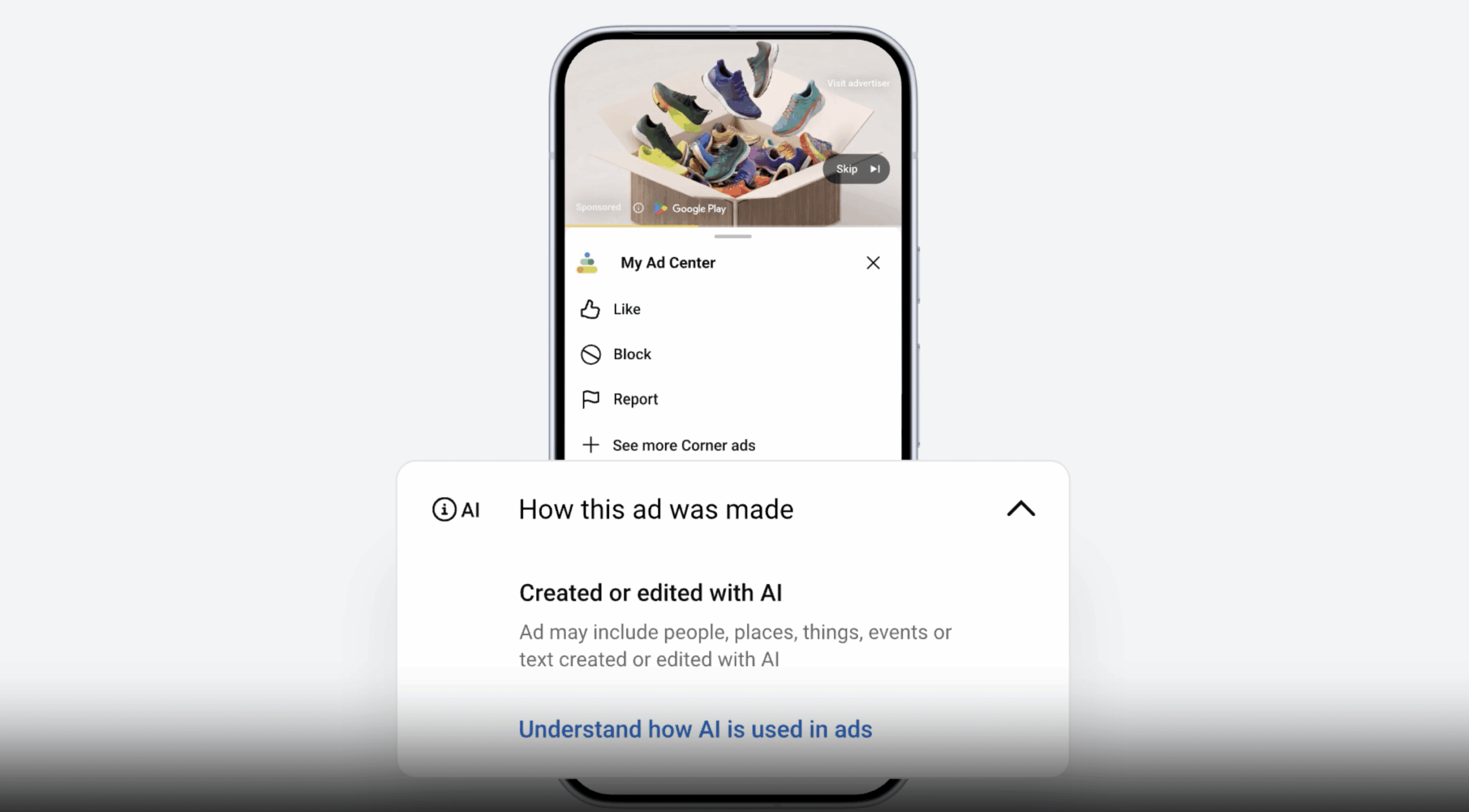
The feature is called “How this ad was made” (something like “how this ad was made”) and will appear inside the My Ad Center panel, accessible via the three-dot menu or the information icon on any ad in Google Search, YouTube, and Google Discover. The rollout is global. So far, according to the official Google announcement, this disclosure requirement only existed for election ads.
The mechanism has two speeds. When the advertiser uses Google’s own generative AI tools to build the ad, the transparency label turns on automatically, by itself. When the advertiser creates the material in another tool (Midjourney, Runway, any third-party image or video generator) and only uploads the finished file to the Google Ads, then the responsibility to disclose is entirely on them. There is a control field to mark “yes, I used AI”, but no one checks whether it was filled out honestly.
The gap in the middle of transparency
That’s the part that interests me most, because it’s the part that most news coverage treated like a footnote. TheNextWeb summed up the issue well: the label only helps if the person who has the most reason to hide decides, on their own, to expose themselves. An advertiser hoping a synthetic scene will pass as a real photo has no incentive to say otherwise, and Google isn’t watching.
There’s an internal inconsistency that makes this even clearer. On YouTube, when the content is a video (not an ad), Google applies an automatic AI label regardless of whether the creator disclosed it, using SynthID and other forms of detection. For ads, the standard is different: self-declaration, with no verification. The same company applying two different levels of rigor for the same kind of content, depending on whether it’s an organic video or a paid ad, says a lot about where the commercial incentive behind each decision lies.
Comparing the transparency systems that exist today
| System | Who verifies | Mandatory? |
|---|---|---|
| Google Ads (Google’s own tools) | Automatic, by Google itself | Yes, with no option to disable |
| Google Ads (third-party tools) | No one, advertiser self-declaration | No, it depends on good will |
| YouTube (videos, not ads) | Automatic via SynthID and Google detection | Yes, regardless of whether the creator gives notice |
| CONAR Brazil (influencers and avatars) | Industry self-regulation, inspection based on complaints | Yes, starting June 1, 2026 |
| EU AI Act (synthetic content in general) | Legal obligation, with government oversight | Yes, starting August 2026 |
Why now: Europe has the measuring stick in hand
The timing isn’t a coincidence. The transparency obligations for AI-generated content under the EU AI Act come into effect in August, only a few weeks after this announcement. Google’s move looks like it’s racing to get ahead of the law before the law arrives with full force, offering a voluntary and softer version than what would likely come by legal obligation. It’s worth remembering that, according to the same report, the retail industry is lobbying to try to exempt AI-generated ads from these European rules. That helps explain why the version Google launched is so much gentler than it could be: it’s the proposal that survives political negotiation, not necessarily the one that is most honest with consumers.
I lived in Lisbon long enough to recognize that pattern. The European Union regulates first and the rest of the world rushes to catch up by adapting only the minimum necessary to keep operating there without rewriting everything from scratch in each market. What’s left for Brazil, in practice, is usually the global “softened” version designed to satisfy the European regulator, not a policy thought for our market.
Brazil is already working on it, just down a different path
While the Google news was circulating, a similar change had already happened here, almost unnoticed. In May, CONAR (the National Advertising Self-Regulation Council) updated its Guide to Advertising by Digital Influencers, adding specific rules for content made with AI, avatars, and virtual influencers, effective starting June 1, 2026. The requirement there is stricter on paper than Google’s: clear, visible, and immediate identification, without needing to click “more” to find out.
The difference is the target. CONAR focused on influencer advertising, not the programmatic buying of media inside Google Ads. That creates a real gap: a brand may be complying with CONAR rules in influencer campaigns and, in the same week, running a synthetic ad in Google Ads without disclosing anything, because technically no one is checking. For anyone managing paid media in Brazil, this gap won’t last. Some regulatory entity, whether CONAR itself expanding scope or the Ministry of Justice under the Consumer Defense Code, is likely to close this loophole.
What changes in practice for people who buy media
Putting aside the principle debate, there are real operational consequences for whoever manages a campaign day to day. This is already changing what we ask for in briefs and what we document in each creative delivery.
- Document the origin of every creative asset: if it was made with Midjourney, Runway, Sora, or any generator, record it in the internal process, regardless of whether or not you mark it in Google Ads. When the requirement becomes mandatory—and it will—you’ll have to reconstruct that history retroactively, which will be far more expensive than documenting it from the start.
- Enable voluntary labeling even without a legal requirement: the cost of using Google’s control to signal AI is zero, and the reputation gain of being the agency that did this before it became mandatory is real, especially for clients who care about compliance.
- Review contracts with creative suppliers: if you outsource image or video production, add a simple clause asking the supplier to inform you when they use generative AI. This prevents you from finding out later, during an audit or a client complaint, that a “photographed” piece was synthetic.
- Follow up on CONAR’s developments: the influencer guide was the first move; it shouldn’t be the last. Programmatic advertising is likely the next natural target for scope expansion, and anyone who already has the internal process organized will adapt without surprises.
- Don’t treat this as disposable bureaucracy: in the AI search environment we discussed in the GEO post, brand authority and trust are increasingly intertwined. A brand that hides AI use in paid ads pays a reputational price that goes beyond the legal sphere.
Byung-Chul Han already had a name for this
The philosopher Byung-Chul Han wrote an entire book about how the word “transparency” has become an almost religious value in contemporary capitalism—used as a badge of virtue even when it hides more than it reveals. He calls it the society of transparency: a discourse of total openness working, in practice, as just another form of control and display, not genuine truth. Google calling a self-declaration system without verification “transparency” is almost a perfect case study of his argument. The word is there, the gesture of openness is there, and the verification—which is what would actually support trust—is simply missing.
What I think about this
At Superplural, the position we’ve been taking is simple: declare the use of AI in advertising creatives before any law requires it, not after. Not because we’re naive about what this costs in terms of brand perception in the short term, but because the trust you build by choosing to be transparent is worth more—and lasts longer—than the trust you pretend to have due to last-minute regulatory obligation. We’ve already seen this happen with how brands build or destroy authority in this new search environment: what’s recorded stays recorded, and generative AI has long-term memory for reputation.
My bet is that, in two or three years, “AI-made ad and not disclosed” will carry the same reputational weight that “unidentified ad” carries today for an influencer. Whoever chooses to get ahead of it now will be first—not because they’re required to, but because they decided to.
Frequently asked questions
Yes. The Google ad was created as a global rollout, including Search, YouTube, and Discover in any market, Brazil included. It doesn’t depend on local legislation to take effect.
Legally, not yet, if you use a third-party tool to create the material before uploading it to Google Ads. Google provides a control for you to mark this voluntarily, but it doesn’t verify or require it. This could change when the EU AI Act fully comes into force in August 2026, and possibly influence future regulation in Brazil.
Yes, they are different systems with different targets. CONAR’s guide, effective since June 1, 2026, focuses on advertising with digital influencers and virtual avatars, requiring clear and immediate identification. Google’s feature targets ads purchased through Google Ads and depends on advertiser self-declaration, with no automatic oversight.
Today, technically nothing happens at the level of Google policy, as long as the ad isn’t misleading or violates other advertising rules that already exist. The risk isn’t immediate penalties—it’s future reputational exposure, as consumer expectations and regulation evolve to require more transparency.